Livestock Overview
Livestock at Grey Barn Farm are managed as part of a long-standing working landscape rather than as isolated enterprises. Animals, land, forage, and seasonal conditions are treated as interconnected systems, with daily decisions shaped by observation, restraint, and long-term continuity rather than by fixed production targets.
The farm itself has remained in the same family since the early nineteenth century, with roots in southeast Missouri and later expansion into southwest Ohio. Over generations, the balance between crops, pasture, and animals has shifted in response to changing conditions, available land, and practical needs. While earlier periods emphasized field production more heavily, livestock have gradually become the organizing center of the farm, providing structure to how land is used, rested, and recovered over time.
Today, livestock are kept at a scale that allows close observation and deliberate management. Animals are maintained in stable social groupings, with ample space and predictable routines that support calm behavior and species-typical activity. Stocking density, movement, and seasonal use are adjusted to protect both animal condition and land function, rather than to maximize short-term output.
A Pasture-Based Framework
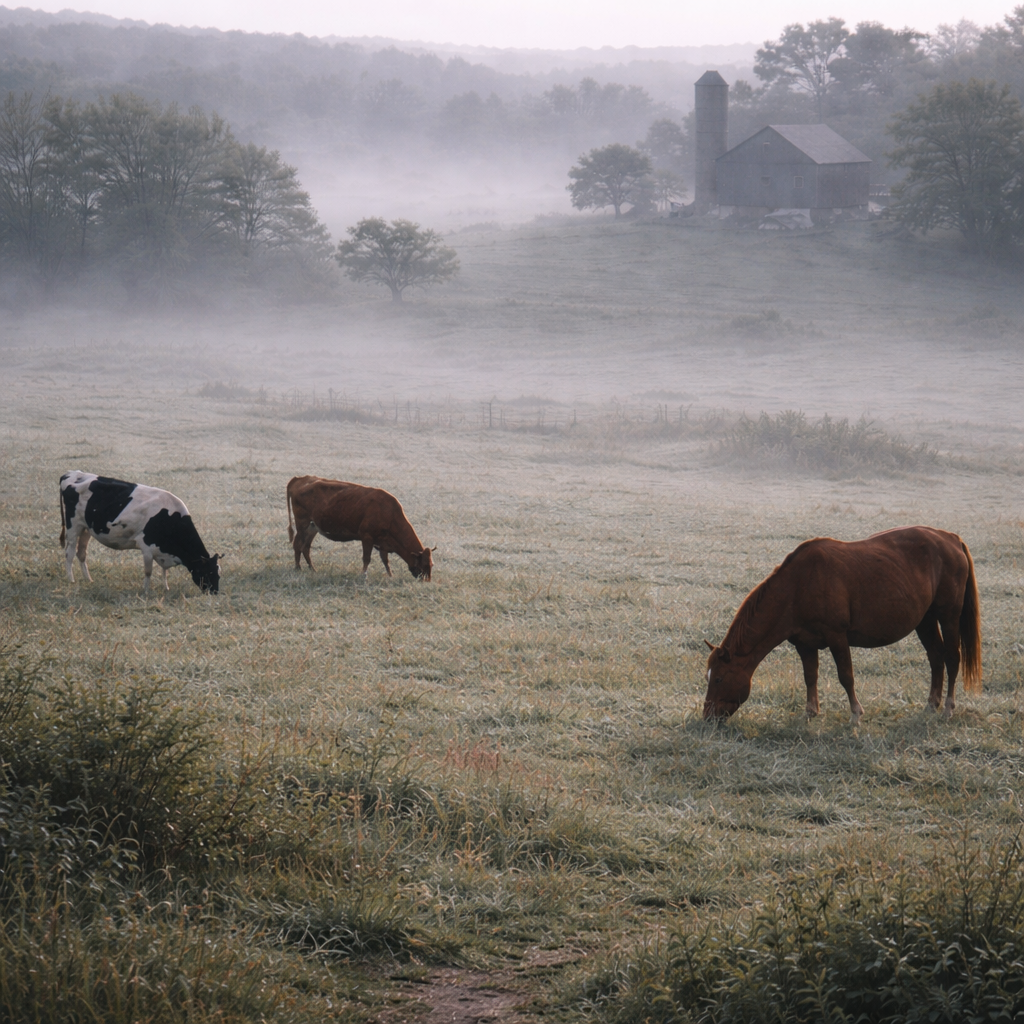
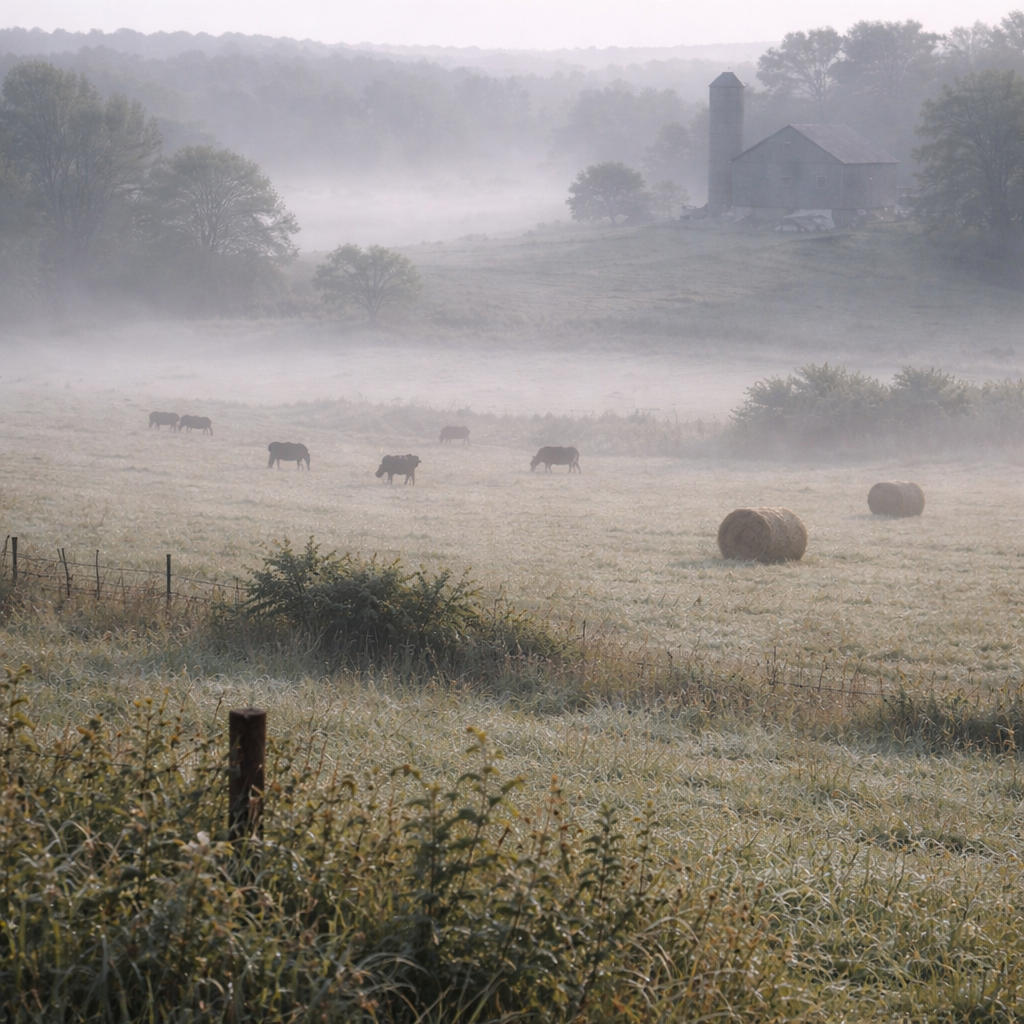
Across species, pasture forms the foundation of livestock management at Grey Barn Farm. Grazing, browsing, rooting, flocking, and ranging behaviors are not treated as inconveniences to be controlled, but as natural functions that can be integrated into land stewardship when scale and timing are appropriate.
Pastures are managed with planned recovery periods, allowing forage plants and soil structure to rebound between uses. Livestock movement is guided by weather, growth conditions, and ground response rather than rigid rotation schedules. In some seasons this means frequent adjustment; in others it means leaving animals in place longer or holding them back entirely. Flexibility is treated as a necessary part of working with living systems.
Species Diversity and Purpose
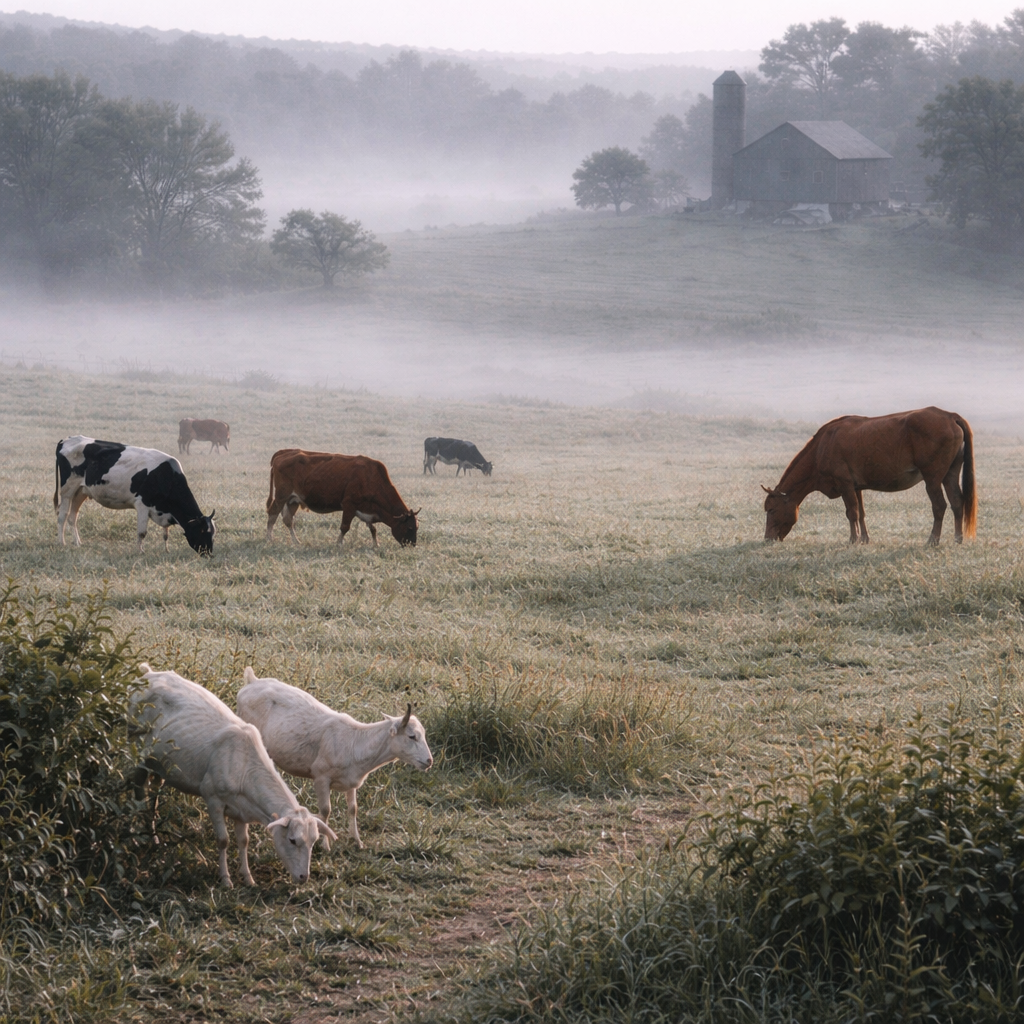
The livestock kept at Grey Barn Farm include cattle, horses, goats, hogs, poultry and waterfowl, rabbits, and bees. Each species serves a distinct role within the broader farm system, and each is managed according to its own biological needs rather than under a single uniform approach.
Cattle anchor the grazing system, influencing pasture composition and nutrient cycling while supporting small-scale dairy production and selective breeding. Horses are maintained primarily as pasture-based animals, used selectively for riding or cattle work and valued for their versatility and long-term usability. Goats contribute dairy products, breeding stock, and land management through browsing behavior, while being kept in small, stable herds that support careful individual observation.
Hogs are maintained primarily as breeding animals, with attention to temperament and structural soundness. In limited, controlled settings, they are also used intentionally for targeted soil disturbance, integrating natural rooting behavior into land preparation without widespread impact. Poultry and waterfowl provide eggs, breeding stock, and seasonal land use benefits, with housing and pasture access designed to accommodate species-specific behaviors and environmental needs. Rabbits are kept in small groups for breeding, companionship placement, and closed-loop fertility through direct manure use. Bees are managed as land-linked livestock, with hive health closely tied to forage availability and field decisions.
None of these species are kept to fill a quota or to meet an external production benchmark. Instead, their presence reflects practical roles that fit within the land, labor, and seasonal constraints of the farm.
Breeding and Continuity
Breeding decisions across species emphasize temperament, sound structure, and adaptability to pasture-based systems. Selection favors animals that remain functional and manageable over time, rather than those optimized for rapid growth, maximum yield, or confinement-based environments.
Closed or semi-closed breeding lines are maintained where feasible, allowing traits to stabilize across generations and reducing reliance on frequent outside replacement. When animals leave the farm, it is typically as breeding stock placed into settings aligned with similar management priorities, rather than as routine turnover.
Land, Forage, and Feed Integration
Livestock management at Grey Barn Farm is inseparable from how fields and forage are handled. Crops and hay are grown primarily to support animal needs, with field production adjusting in response to herd size, winter requirements, and weather patterns. Fields are rotated or rested as needed, and livestock numbers are shaped by what the land can reasonably sustain.
This integration reduces dependence on purchased inputs and keeps decision-making grounded in what the farm itself can provide. It also reinforces a feedback loop in which animal condition, forage growth, and soil response inform one another over time.
Record-Keeping and Observation
Animals and fields are tracked with detailed records that preserve context across seasons and years. Health events, breeding outcomes, pasture use, and environmental conditions are documented to support informed adjustments rather than to enforce rigid plans. Observation remains central, but records ensure that decisions are anchored to actual history rather than memory alone.
How This Section is Organized
The livestock section of this site is organized by species, with individual pages describing how each group is managed in practice and how it fits into the broader farm system. These pages are intended to be descriptive rather than instructional, outlining routines, constraints, and decision-making processes specific to this setting.
Because daily care practices can be extensive and highly context-dependent, more detailed documentation for some species is maintained separately. Where applicable, links are provided for readers interested in deeper, day-to-day records of care, housing, feeding, breeding, and observation.
A Working, Evolving System
Grey Barn Farm is not organized around scale, speed, or uniformity. Livestock systems here are shaped by experience, adjustment, and respect for limits - of land, animals, and people alike. By keeping animal numbers manageable, allowing land time to recover, and treating variability as normal rather than problematic, the farm continues a long tradition of practical stewardship focused on durability and continuity.