Hay
Overview
Hay forms the structural backbone of the field system at Grey Barn Farm. Unlike annual grain crops, hayfields persist across multiple seasons, carrying both forage production and field condition forward over time. Decisions surrounding hay are shaped less by individual years and more by continuity - how ground responds to repeated use, rest, and regrowth across longer spans.
Hayfields are managed as living systems rather than short-term outputs. Their role extends beyond harvested forage to include soil protection, root structure, and biological stability, supporting both livestock needs and long-term land function.
Role Within the Livestock System
Hay provides consistent forage across seasons, bridging periods when pasture growth slows or becomes unavailable. It supports livestock during winter feeding and transitional periods, reducing pressure on grazing ground and allowing pasture recovery to proceed without interruption.
Rather than maximizing yield, hay production is paced to preserve stand longevity and forage quality over time. Harvest decisions consider livestock needs first, followed by field condition and regrowth potential.
Composition and Planting
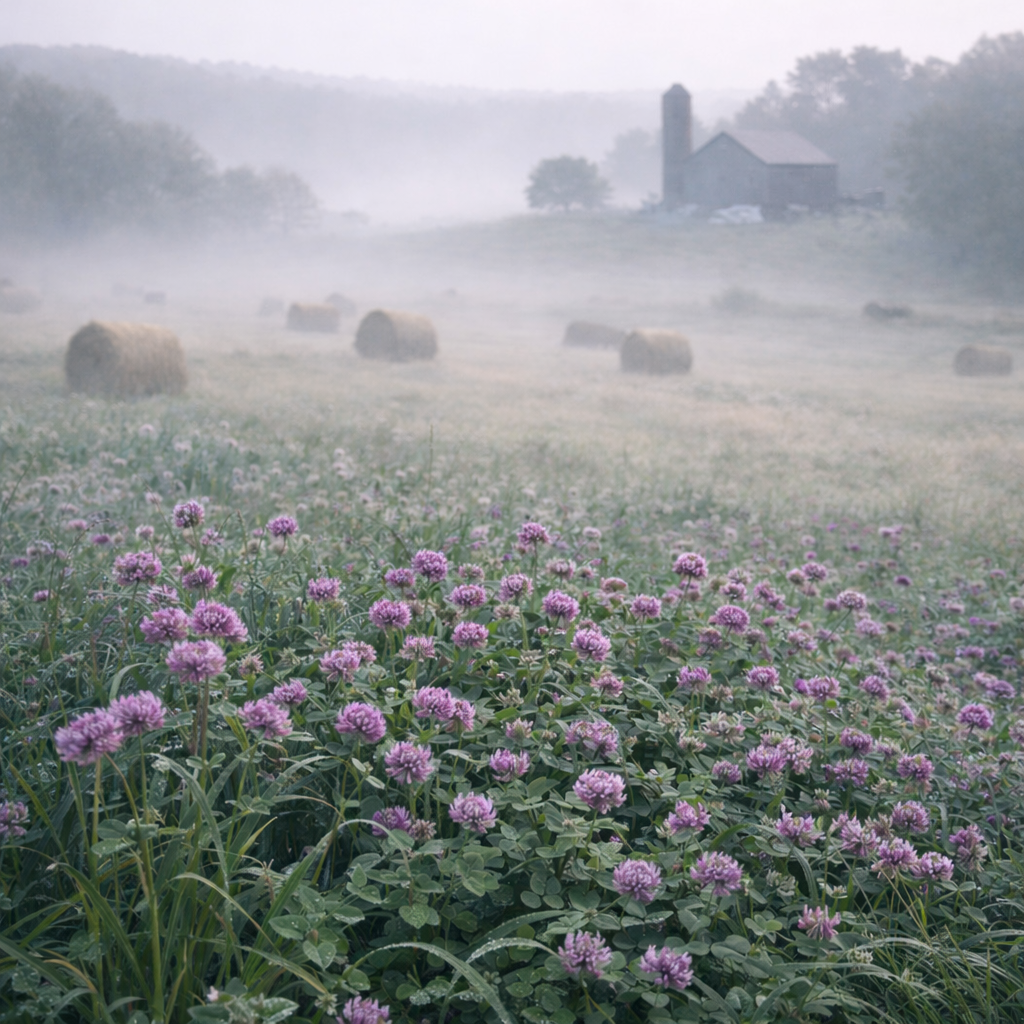
Hayfields at Grey Barn Farm consist primarily of mixed grass stands, with clover incorporated where appropriate. Clover is seeded into hayfields both to support forage diversity and to contribute to soil health through biological nitrogen fixation.
These mixed stands are managed as integrated systems rather than separated by species. Grass and clover are harvested together, reflecting how they function in the field and how they are ultimately used by livestock.
Field Selection and Longevity
Fields selected for hay are chosen for their ability to support repeated harvest while maintaining structure and cover. Drainage, slope, and historical response guide which fields remain in hay and which are transitioned to other uses.
Some hayfields remain in place for many years. Others are temporary, serving as a stabilizing phase within a longer rotation. Decisions to keep, renovate, or retire a hayfield are based on observed stand health rather than preset timelines.
Cutting and Timing
Cutting schedules are guided by plant maturity, weather conditions, and regrowth capacity rather than fixed dates. Harvest timing balances forage quality with the need to preserve root reserves and maintain stand vigor.
Operations are delayed when soil moisture or weather increases the risk of compaction or damage. Missed cuttings are accepted when conditions favor restraint, with long-term field health prioritized over short-term tonnag
Soil Surface and Recovery
Hayfields provide continuous soil cover for much of the year, reducing erosion and moderating temperature and moisture fluctuations. Root systems contribute to soil structure, while surface residue supports biological activity and water infiltration.
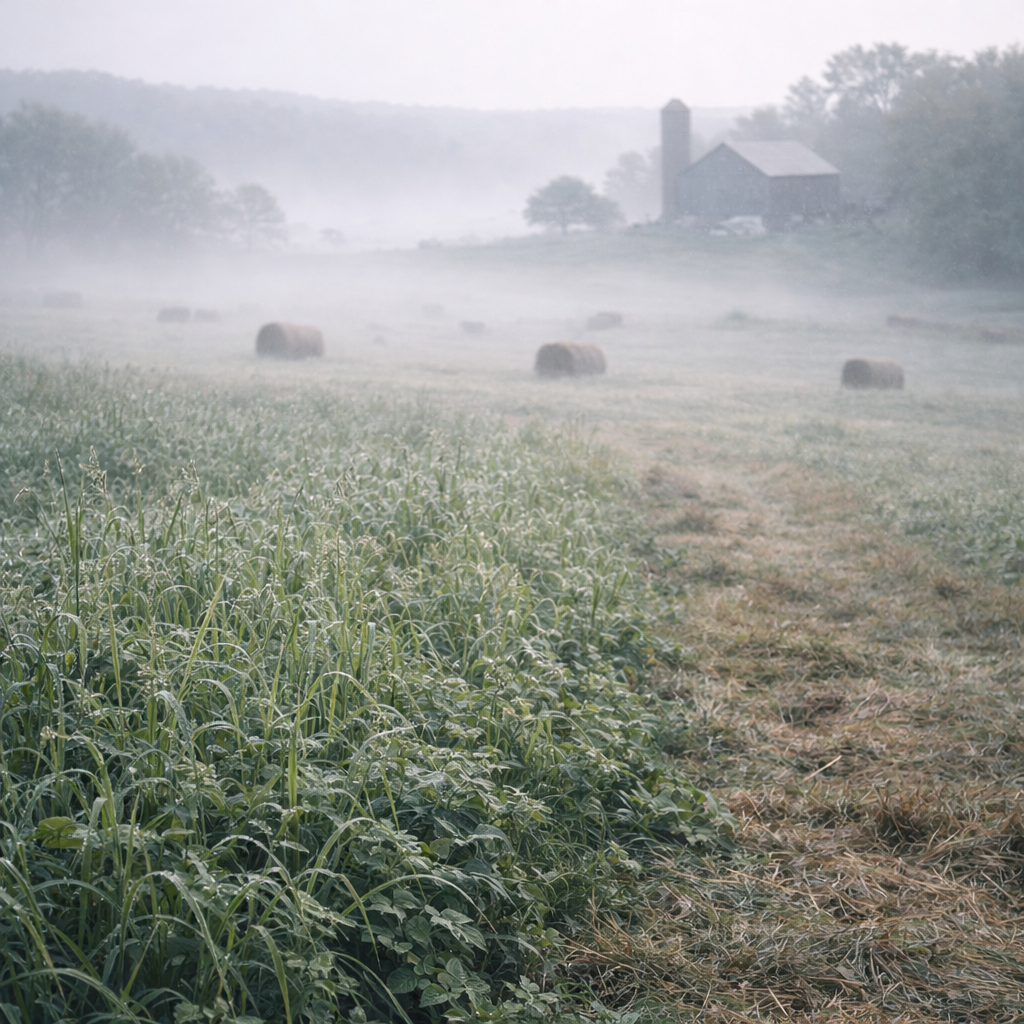
Periods between cuttings are treated as recovery intervals rather than idle time. Fields are allowed to regrow fully before subsequent harvests, supporting persistence and resilience.
Inputs and Amendments
Nutrient management for hay is conservative and responsive. Manure and lime are applied selectively based on soil testing, field history, and observed stand response rather than routine schedules.
Chemical inputs are used sparingly. Weed pressure is evaluated as an indicator of stand health, cutting timing, and soil condition rather than treated in isolation.
Weather and Variability
Weather plays a central role in hay management. Rain patterns, humidity, and temperature influence both cutting windows and drying conditions, requiring flexibility and frequent reassessment.
Some years favor multiple harvests; others limit cutting opportunities. Variability is treated as inherent rather than problematic, shaping expectations and management decisions accordingly.
Harvest, Storage, and Use
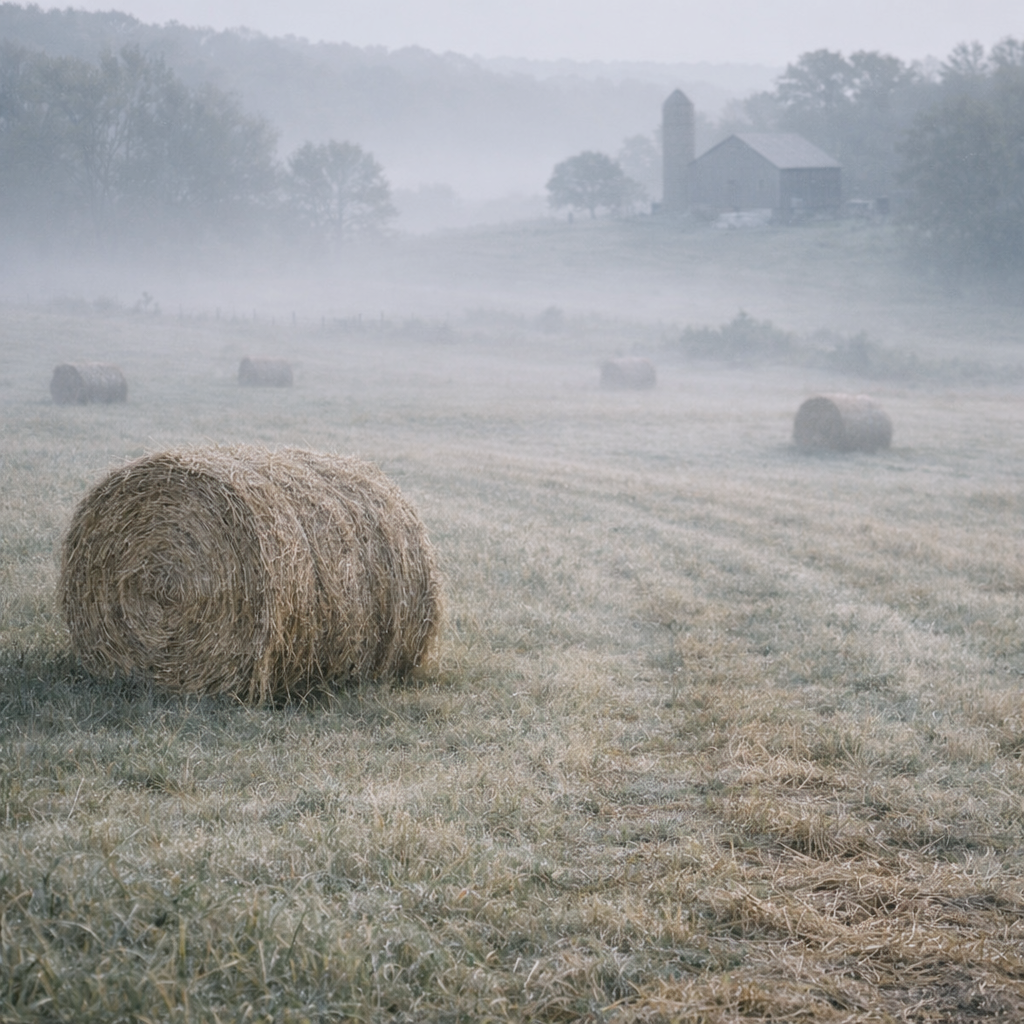
Harvested hay is stored for on-farm use, with quality and consistency prioritized over appearance. Bales are incorporated into livestock feeding programs based on species, season, and forage availability.
Use varies year to year, reflecting livestock numbers, pasture conditions, and overall forage balance across the farm.
Records and Field History
Hayfields are tracked in the same manner as other fields, with records documenting seeding, amendments, harvest timing, yield estimates, and observed response. Weather data and cutting outcomes contribute to long-term understanding of each field's capacity and limits.
These records inform future decisions about whether a field remains in hay, transitions to another use, or enters a period of rest.
Hay in a Long View
At Grey Barn Farm, hay is not treated as a background crop. Its long presence shapes soil structure, forage availability, and livestock stability across seasons. By managing hayfields with patience and restraint, they remain productive without becoming depleted.
Success is measured by persistence and function - fields that continue to support animals and recover predictably year after year.