Field Stewardship
Overview
This page expands on the forage and feed crop overview page by describing how field work is approached, timed, and recorded over time. It reflects how fields are managed in practice, within a working livestock system, and how decisions adjust in response to soil conditions, weather, and accumulated field history.
The focus here is not on methods in isolation, but on continuity - how individual fields are treated as long-lived parts of the farm, shaped gradually rather than pushed toward short-term output. What follows is descriptive rather than instructional, and reflects what has been workable in this setting over many seasons.
What Fields Are Used For Here
Fields exist primarily to support livestock. Crops are grown to provide feed, forage stability, and seasonal flexibility, rather than as stand-alone production targets. Decisions about planting, harvest, and rest are made with animal needs, storage capacity, and long-term ground condition in mind.
Yield is not treated as the sole measure of success. A field that remains structurally sound, responsive to moisture, and predictable year to year is considered functional, even if it is not pressed for maximum output in a given season.
Observation Before Action
Most field decisions begin with observation rather than scheduling. Before any work is done, attention is given to surface condition, residue cover, soil moisture, trafficability, drainage behavior, and signs of compaction. Weed pressure is observed as an indicator of conditions rather than treated as a problem in isolation.
Weather patterns - both recent and forecast - are considered alongside these field-level observations. The goal is to understand what the ground is ready for, and what it is not, rather than to move work forward by default.
Rotation and Rest
Rotation is practiced at a high level and varies by field and by year. Sequences are not fixed, and adjustments are common. Rest is treated as an active management choice rather than an absence of use.
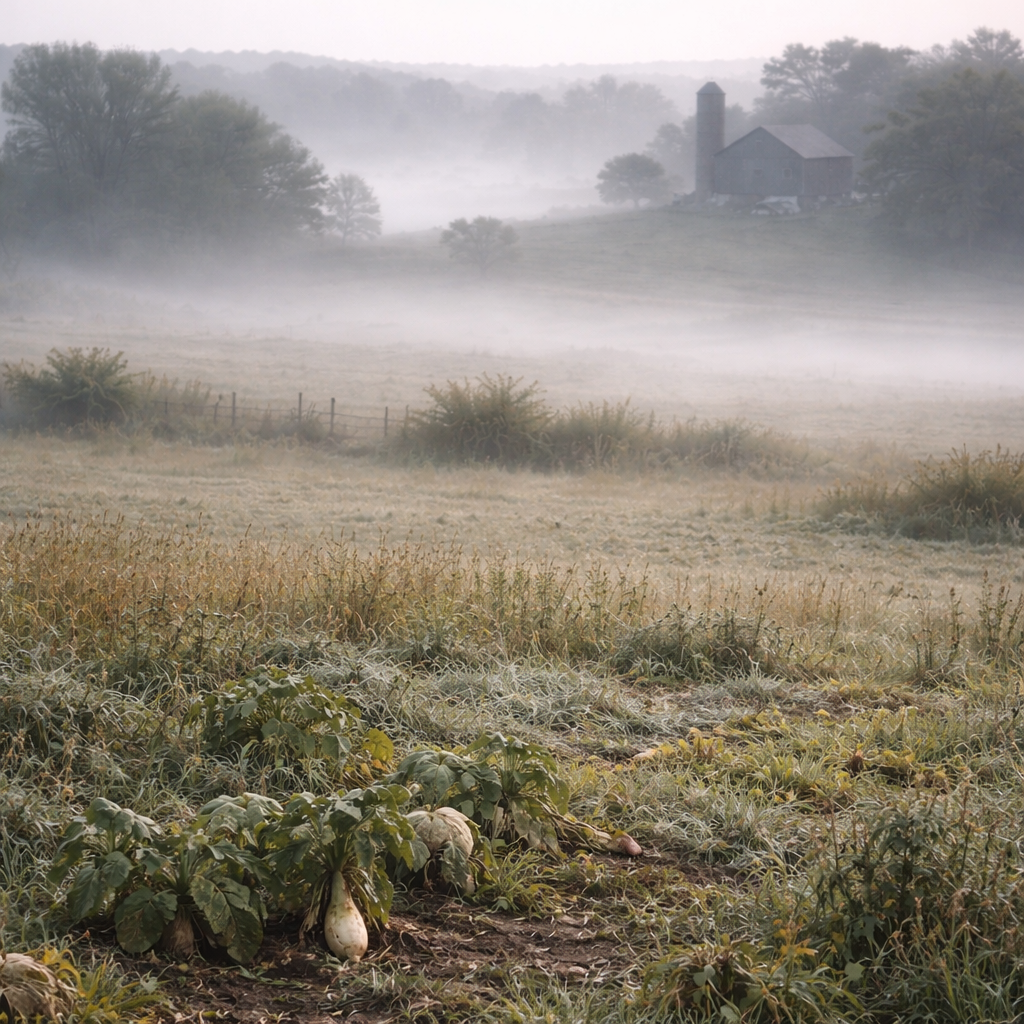
When fields are rested, daikon is often planted and left to winter-kill and decay in place. This is done to support soil structure and infiltration without additional disturbance. Rest periods are allowed to run their course, even when that means delaying a return to production longer than originally planned.
Soil Surface: Cover, Residue, and Moisture
Maintaining a protected soil surface is a consistent priority. Residue is left in place where possible to reduce erosion, limit moisture loss, and protect structure. Bare ground is avoided unless conditions clearly support it.
Field work is timed to minimize damage to soil aggregates and surface integrity. The appearance of a field is considered secondary to how it functions under rainfall, drying, and traffic.
Amendments and Inputs
Manure, lime, and similar amendments are used as part of maintaining soil function and nutrient balance. Applications are based on field history and observed need rather than routine schedules.
Herbicides and other chemical inputs are used infrequently, and only when conditions justify their use in this system. Their application is treated as one tool among many, not as a default response.
Weather as the Primary Scheduler
Field work adjusts year to year. Planting dates shift, harvest windows move, and some work is postponed or skipped entirely when conditions are not favorable. Weather is treated as the primary scheduler, not as an obstacle to be worked around.
Leaving a field alone - sometimes longer than expected - is understood as a valid outcome when conditions warrant it.
Equipment Use and Pass Count
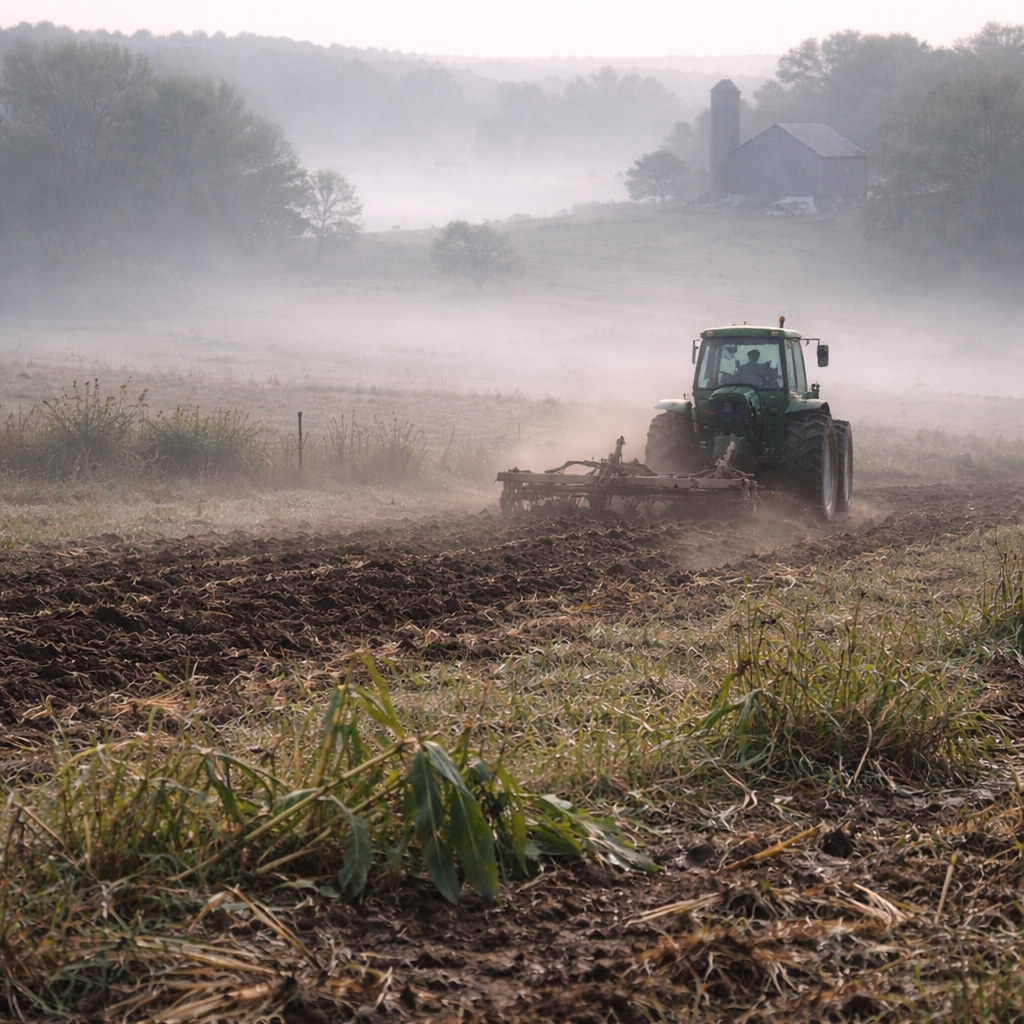
Equipment is selected, maintained, and used with restraint. Fewer passes are preferred when possible, and ground is avoided when traffic would cause harm.
The aim is not to work ground quickly or frequently, but to intervene only when conditions support it and when the work serves a clear purpose within the broader system.
Field Records and Continuity
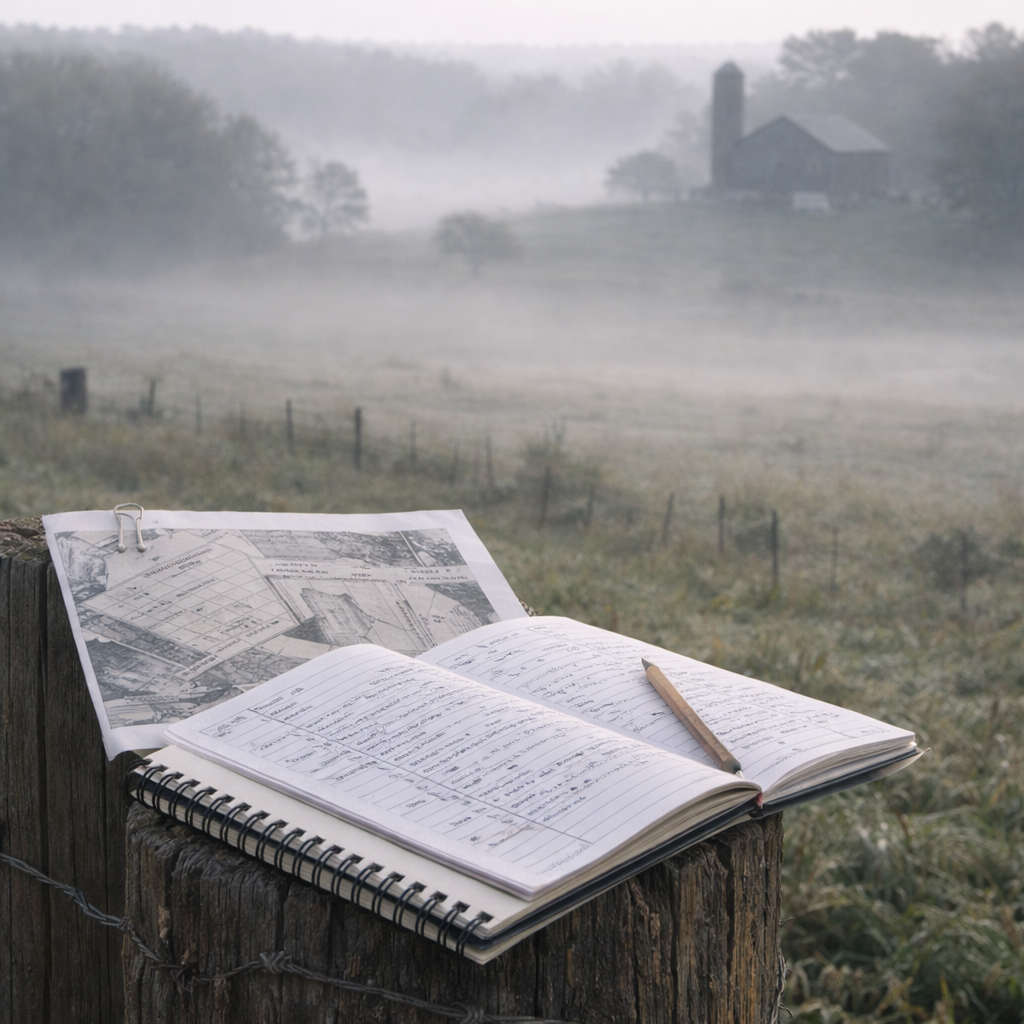
Fields are tracked in FarmBrite in much the same way livestock are tracked. Each field carries its own history, including acreage, plantings, operations, amendments, observations, harvest outcomes, and notes accumulated over time.
Records are used to preserve context. Decisions are grounded in what has already occurred on a given field rather than relying on generalized guidance or memory alone.
Environmental Monitoring
In addition to field records, environmental conditions are logged both in real time and historically. These records include daily high and low temperatures, soil temperature and moisture, humidity, wind speed and direction, and light intensity.
Over time, this data helps clarify patterns and constraints, supporting decisions that are responsive rather than reactive.
Variability as an Expected Condition
No two fields behave the same way, and no two seasons repeat. Field responses vary with weather, prior use, and accumulated history. Management remains flexible by necessity.
There is no requirement to extract value from every square acre every year. Long-term stewardship and functional ground take precedence over short-term optimization.
Relationship to Forage and Feed Crops
This page provides additional detail on how field work is timed, documented, and adjusted over time. For a higher-level overview of forage and feed crops within the farm system, see the Forage & Feed Crops page.