Soybeans
Overview
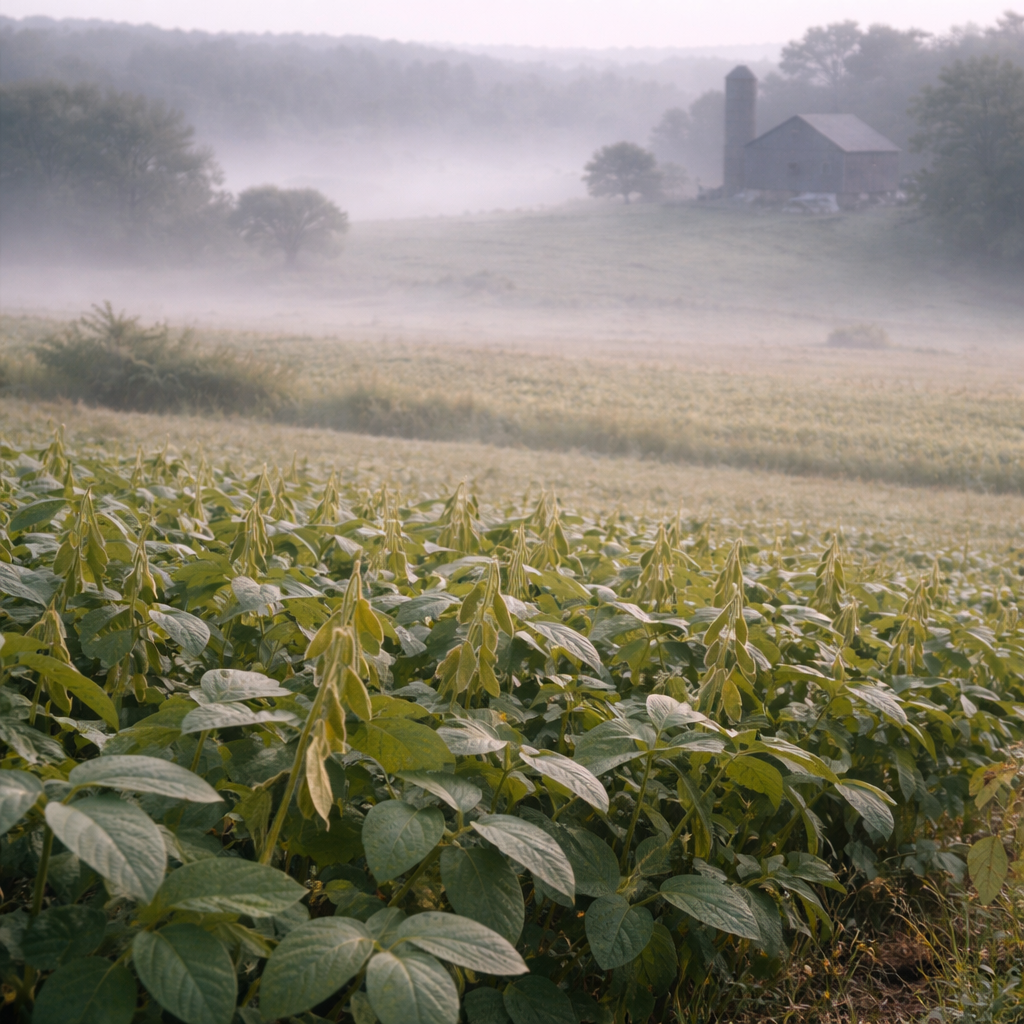
Soybeans occupy a flexible and deliberately limited role within the field system at Grey Barn Farm. They are grown as part of longer rotational sequences, contributing to soil balance, feed diversity, and seasonal adaptability rather than serving as a dominant or continuous crop. Decisions about whether and where soybeans are planted reflect field history, soil condition, weather patterns, and how a given parcel fits into the broader needs of the livestock system.
Soybeans are not treated as a default planting. In some years they play an important role; in others they are reduced or omitted entirely in favor of rest, forage, or alternative crops. This variability is intentional and reflects the farm's emphasis on responsiveness over routine.
Role Within the Field System
At this farm, soybeans are valued primarily for their place within rotation rather than for yield alone. Their ability to complement other crops and contribute to soil balance makes them useful in specific sequences, particularly following heavier-use crops or ahead of forage or rest periods.
Soybeans also provide feed flexibility when incorporated into livestock rations. Their use is adjusted by species, season, and availability of other on-farm feeds, rather than fixed inclusion rates. As with other crops, acreage is scaled to actual need rather than projected output.
Field Selection and Placement
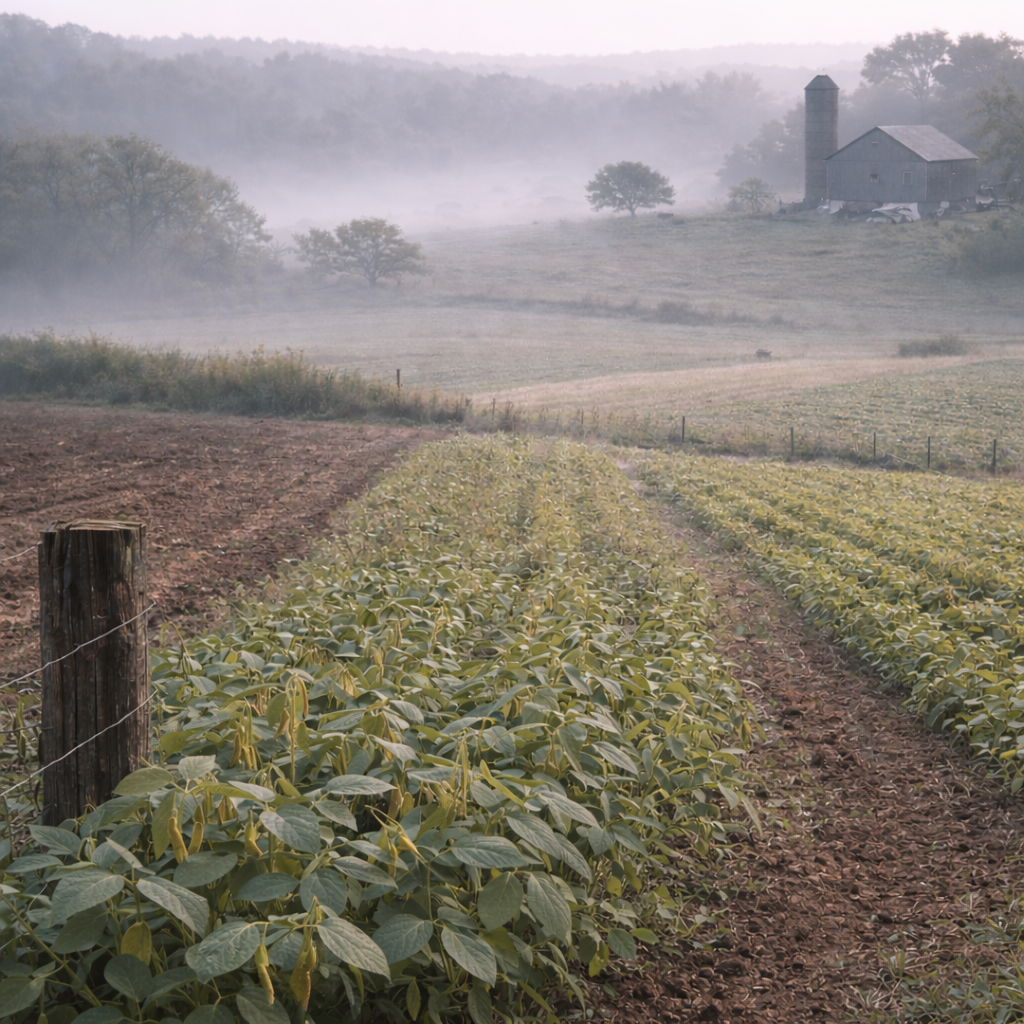
Not all fields are suitable for soybeans in a given season. Placement is informed by drainage characteristics, compaction risk, residue levels, and prior crop history. Fields that would benefit from reduced traffic or extended recovery may be held out of soybean production even when they might otherwise be considered appropriate.
Because soybeans are sensitive to soil condition at planting, decisions are paced by ground readiness rather than calendar dates. Fields are observed closely for surface stability and moisture, and planting is delayed or abandoned if conditions are likely to cause damage.
Rotation and Sequencing
Soybeans are never grown continuously. Their value lies in how they interact with other crops and with rest periods over time. Sequences are adjusted field by field, with attention to how soil structure, residue cover, and biological activity respond across seasons.
In some cases, soybeans follow corn or other grain crops; in others, they precede forage or longer rest intervals. There is no fixed pattern imposed across the farm. Instead, each field's rotation reflects accumulated experience with that specific ground.
Soil Surface and Residue Management
Maintaining soil cover remains a priority in soybean fields, particularly given their canopy development and sensitivity to early-season conditions. Residue from previous crops is retained where possible to protect the soil surface, reduce erosion, and moderate temperature and moisture swings.
Field operations are minimized when conditions are marginal. The appearance of uniformity is secondary to preserving soil function and avoiding compaction that could persist beyond a single season.
Nutrient Balance and Inputs
Soybeans are managed with restraint regarding inputs. Nutrient needs are evaluated in the context of field history, soil testing, and observed crop response rather than standardized prescriptions. Amendments such as manure or lime are applied selectively and timed to support long-term soil function rather than short-term crop response.
Chemical inputs, including herbicides, are used sparingly and only when conditions justify their use within this system. Weed pressure is evaluated as an indicator of field condition and timing rather than treated as an isolated problem.
Weather and Variability
Soybean performance varies significantly with weather, and management decisions reflect this reality. Excess moisture, dry periods, temperature swings, and storm timing all influence both establishment and outcome. Rather than attempting to standardize results, variability is accepted as part of working with living systems.
In some seasons, weather patterns favor soybeans; in others, they do not. Adjusting acreage or abandoning planting when conditions are unfavorable is treated as a practical decision rather than a setback.
Harvest and Use
Harvest timing is guided by crop maturity, field condition, and weather outlook. Protecting the field itself remains a priority, and harvest may be delayed or accelerated depending on soil moisture and traffic risk.
Once harvested, soybeans are used as part of the farm's broader feed system. Their role shifts depending on livestock needs, forage availability, and storage considerations, reinforcing their function as a flexible support crop rather than a fixed endpoint.
Records and Field Continuity
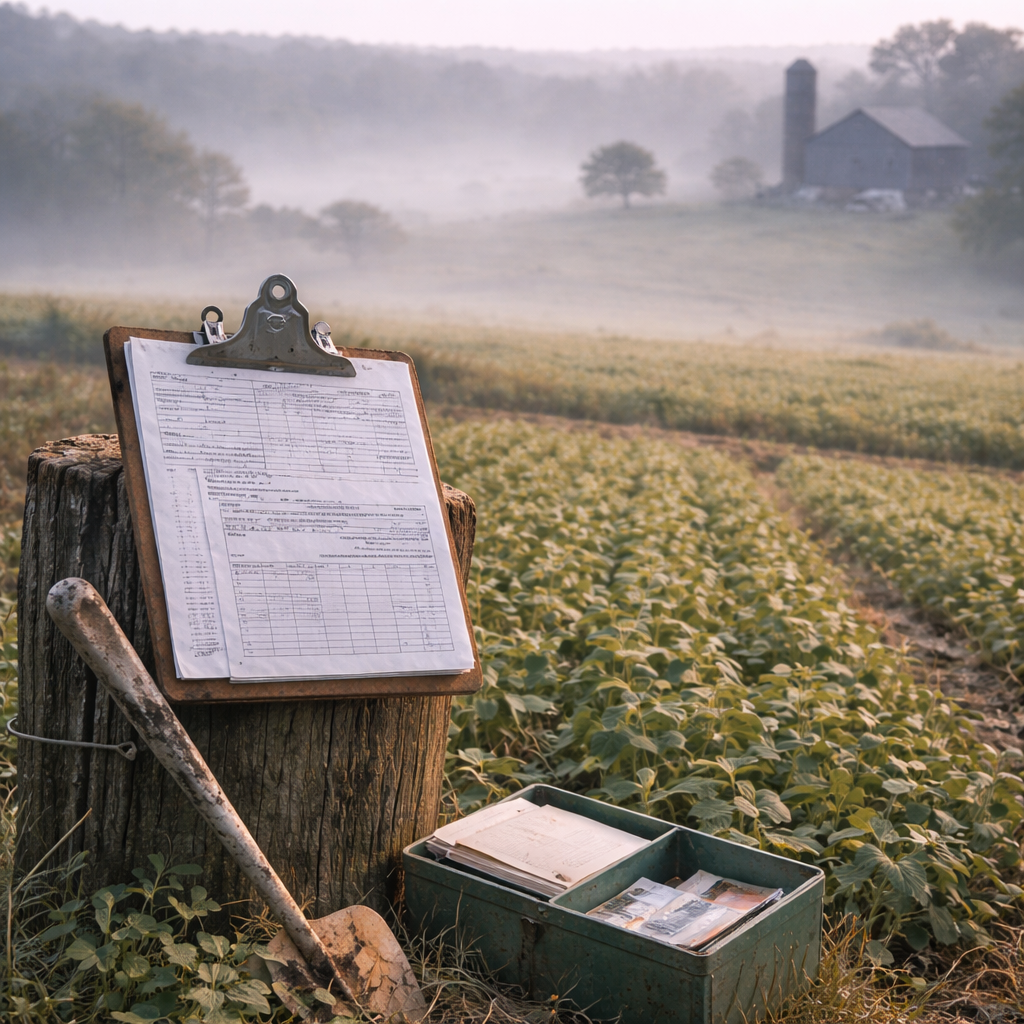
Soybean fields are documented alongside other crops and livestock using FarmBrite, with records that include planting decisions, amendments, observations, weather context, and harvest outcomes. These records help preserve field-specific knowledge over time, allowing decisions to build on what has actually occurred rather than on generalized expectations.
Patterns observed across multiple seasons inform whether soybeans remain a good fit for a given field, or whether rotation, rest, or alternative use would better support long-term land function.
Soybeans in a Long View
At Grey Barn Farm, soybeans are not managed for scale or consistency. Their value lies in how they fit within a larger system that prioritizes soil structure, flexibility, and continuity. By allowing acreage to expand, contract, or pause entirely based on conditions, soybeans remain a useful tool rather than a limiting commitment.
Success is measured not by uniform stands or maximum yields, but by whether fields remain resilient, predictable, and capable of supporting both crops and livestock over time.