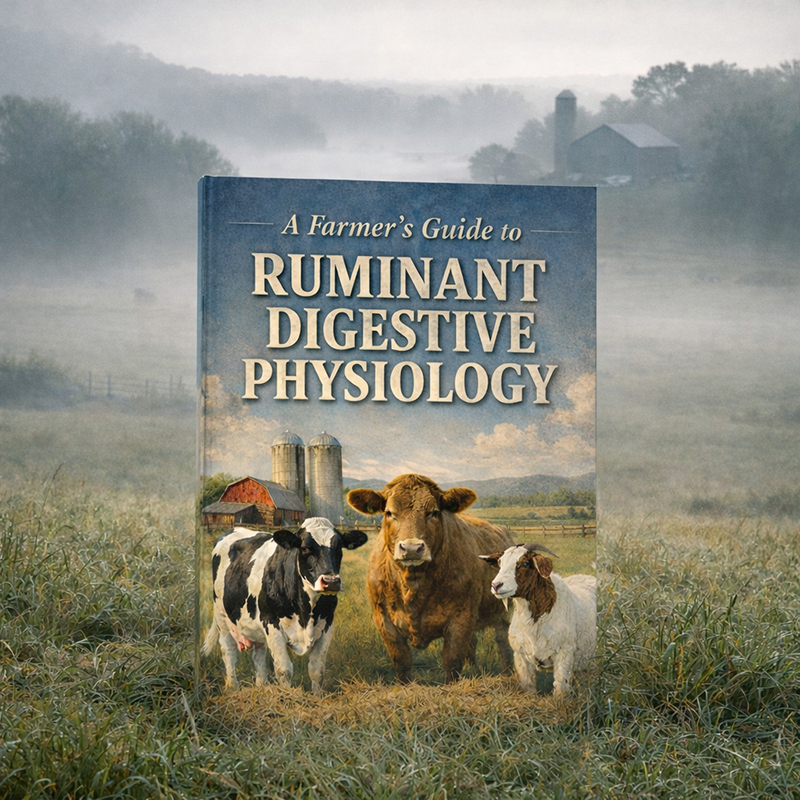

A Farmer's Guide to Ruminant Digestive Physiology
Most people who search for information about ruminants are not looking for theory. They are trying to understand what is happening in front of them - in the bunk, in the pasture, in the milk line, or on the scale. This book treats the ruminant for what it is: a managed fermentation system with a small intestine attached.
Fermentation comes first. Microbes process the feed. The animal lives on the products of that fermentation. Once that frame is steady, intake swings, milk fat shifts, loose manure, and unexplained instability begin to make physiologic sense.
Anatomy is handled as function, not memorization. The rumen and reticulum operate as a single fermentation engine. The omasum regulates flow. The abomasum acidifies and restores enzymatic digestion. Motility patterns mix, stratify, and clear gas. Saliva delivers buffer in proportion to chewing, and its quantitative capacity matters. Goat and cattle differences appear where they are structural and meaningful - as consequences of relative rumen volume, intake rhythm, and feed selection.
Feed is treated as time, not just percentage. Fiber carries a rate of degradation shaped by lignification and particle size. Starch ferments on a different clock. Protein fractions move through degradable and undegradable pathways, with microbial capture depending on synchronization with energy. Lipids shift microbial ecology above defined thresholds. Minerals change solubility as pH moves. Water alters osmolarity, passage, and intake regulation. The rumen is a dynamic vat, not a static container.
Beyond the rumen, microbial protein becomes the primary amino acid source. Bypass nutrients enter enzymatic digestion. The liver converts propionate to glucose. Fat mobilization alters whole-animal energy balance. Development from kid or calf to functional ruminant reflects structural change in papillae, fermentation capacity, and intake pattern. Season, temperature, forage variability, and parasite load all shift metabolic demand and microbial equilibrium in observable ways.
When systems drift, they do so along predictable mechanical lines. Acids accumulate faster than they are absorbed. Foam traps gas. Energy demand exceeds intake. Mineral interactions cascade. Early instability leaves markers before overt failure appears.
Across all of it runs a simple principle: stability outperforms extremes. Microbial turnover sets the biological clock. Intake rhythm matters more than single-day peaks. Systems that scale, recover, and persist outperform those pushed to the edge.
This book explains how the pieces fit together so that what you already observe in goats and cattle can be understood in clear, integrated physiologic terms.
A printable PDF glossary of terms in this book is availsble for download here.
Grey Barn Farm Publishing, an imprint of Grey Barn Farm, exists to support careful, evidence-grounded writing on agriculture, biology, and the long-term relationships between humans, animals, and landscapes. Our focus is on work that values precision over persuasion, explanation over narrative convenience, and durability over trend - whether the subject is domestication, animal physiology, land stewardship, or applied science. We publish with the same philosophy that guides the farm itself: respect for constraints, attention to mechanism, and skepticism of overly tidy stories.
If you believe your work aligns with the mission of Grey Barn Farm Publishing, we welcome hearing from you. Authors seeking thoughtful guidance in writing, production, or preparation for publication are invited to reach out via our Contact page.